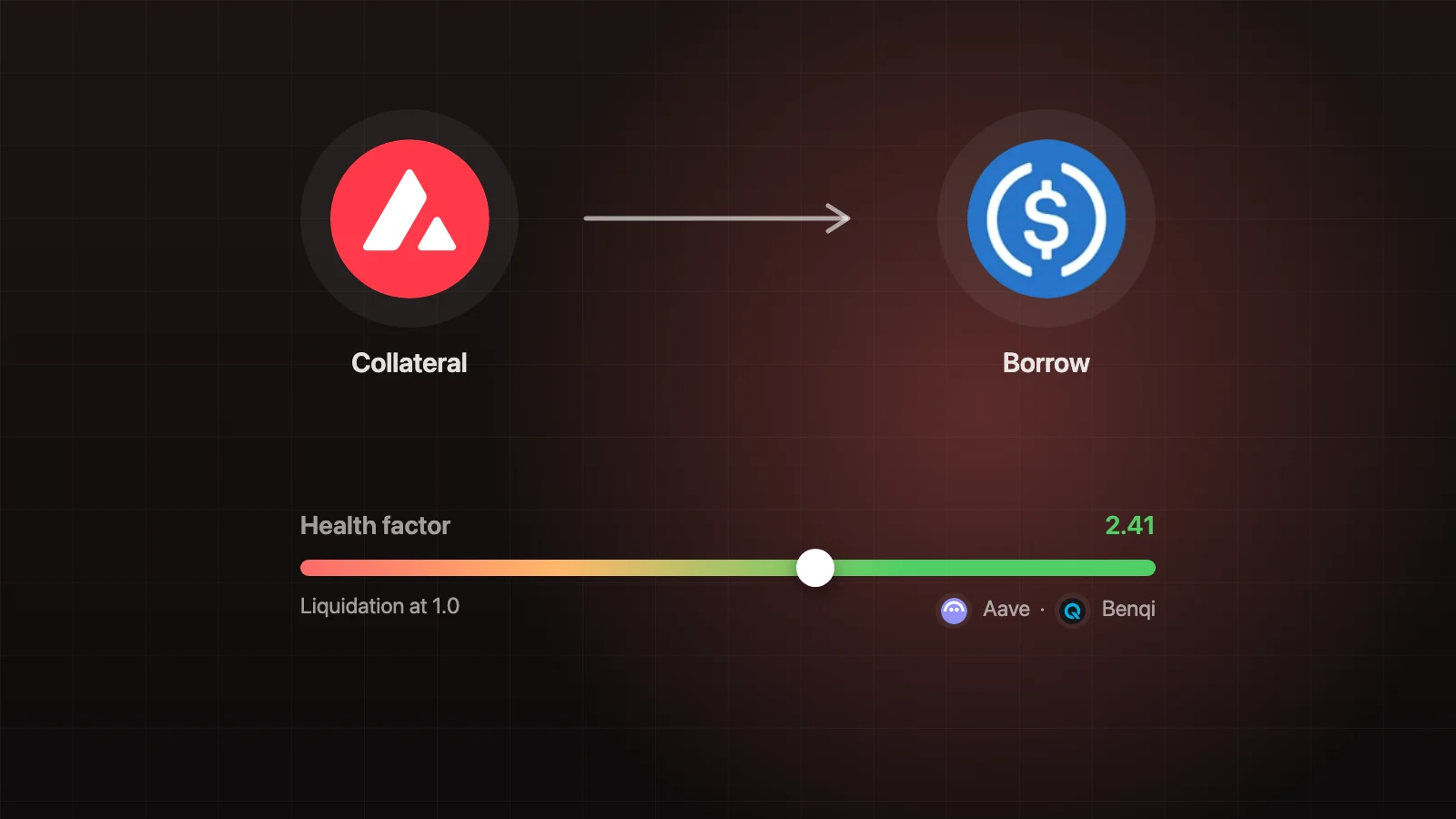
To borrow against AVAX, you supply it as collateral to a lending protocol such as Aave or Benqi, then borrow another asset, usually a stablecoin, up to a limit the protocol sets. You keep your AVAX exposure. If AVAX falls far enough relative to your debt, the protocol lets a liquidator repay part of your debt and take some of your collateral at a discount. Avoiding that comes down to three habits: borrow well below your limit, watch your health factor, and act before it nears 1.
This guide explains how the protocols work, not what you should do with your money.
The four numbers that matter
Max LTV. The share of your collateral's value you can borrow when you open or increase a position. Aave calls it LTV; Benqi calls its equivalent the collateral factor. Both are set per asset.
Liquidation threshold. The point where the position becomes liquidatable. On Aave it's set per asset and sits above the max LTV. That gap is a small built-in buffer: borrowing right at max LTV doesn't liquidate you immediately, but it leaves little room.
Health factor. Aave's help center defines it as total collateral value × weighted average liquidation threshold ÷ total borrowed value. Above 1 you're safe from liquidation; below 1, liquidators can step in. Benqi uses a figure called Health, the ratio of your collateral to your borrowed value, with the same line at 1. Benqi's docs describe Health above 2 as safe from liquidation, below 1.1 as high risk, and below 1 as liquidation.
Liquidation penalty. The bonus a liquidator earns, paid out of your collateral. More on that below.
How far AVAX can fall
A worked example with made-up parameters. Real thresholds differ by asset and change through governance, so check the current values before you borrow.
You supply AVAX worth $1,000. Assume a liquidation threshold of 70%. You borrow $350 of USDC.
Health factor = ($1,000 × 0.70) ÷ $350 = 2.0
If you borrowed a stablecoin, your debt stays roughly flat while AVAX moves, so the AVAX drop that brings you to 1.0 is about 1 − 1 ÷ health factor:
| Starting health factor | AVAX drop that reaches 1.0 |
|---|---|
| 3.0 | about 67% |
| 2.0 | about 50% |
| 1.5 | about 33% |
| 1.25 | about 20% |
| 1.1 | about 9% |
This ignores interest and any other assets in the position. AVAX can move sharply within hours, so the bottom rows leave less room than they appear to.
Your debt grows on its own
Borrow rates on Aave and Benqi are variable. They rise as more of a market is borrowed, and Benqi's jump rate model makes them rise sharply above a set utilization level. Two effects follow:
- Interest accrues continuously, so your health factor drifts down even if prices don't move.
- A rate that looked cheap when you borrowed can climb when the market gets busy.
What liquidation costs
When your health falls below 1, a liquidator repays part of your debt and takes some of your collateral in return, plus a bonus.
- Aave: up to 50% of your debt can be repaid in one liquidation while the health factor is above 0.95 and both collateral and debt are at least $2,000. At 0.95 or below, or on a smaller position, it can be 100%. The liquidation bonus is set per asset by governance.
- Benqi: a close factor caps how much debt can be repaid per liquidation (50% in Benqi's docs), and the liquidation incentive is "usually 10%".
Either way you lose more collateral than the debt repaid, usually in a falling market, so you're effectively selling AVAX near a low.
Habits that keep a buffer
None of these guarantee anything. They're common ways borrowers manage the risk.
- Treat max LTV as a ceiling, not a target. The further your health factor is from 1, the more time you have to react.
- Pick your action point in advance. For example: "At health 1.5, I repay a quarter of the debt." Decide while you're calm, not mid-drop.
- Borrow something that doesn't move with your collateral. A stablecoin against AVAX means only one side of the position swings. A volatile asset against AVAX adds a second moving part.
- Keep repayment funds and gas ready. Some of the borrowed asset and a little AVAX in your wallet let you act in one transaction.
- Check the exact token. On Avalanche, native USDC and bridged USDC.e are separate markets, and you repay the token you borrowed (USDC vs USDC.e).
To raise your health factor, repay part of the debt (usually the most direct fix), add collateral, or close the position: repay in full, then withdraw.
Borrowing in Wyro, step by step
Wyro connects to Aave V3 and Benqi on Avalanche. Borrowing is provided by their smart contracts; Wyro doesn't lend, set rates, or hold your funds, and you sign every step.
- Open Trade → Borrow and, under Choose a protocol, tap Aave or Benqi.
- On What to Borrow?, pick an asset. Each shows its variable APR, with a Historical Borrow APR chart.
- Pick your collateral. The summary shows its Max LTV, Liquidation Threshold, and Liquidation Penalty on that protocol. If you already have collateral there, you can borrow against it and skip the deposit.
- On Deposit Collateral, enter the amount. Borrow Power shows what it lets you borrow.
- On Confirm Borrow, enter how much to borrow. If the collateral needs to be enabled, Wyro adds an Enable as collateral step first. Wyro simulates each C-Chain transaction with Tenderly and shows the expected balance changes before you sign (how simulation works).
On Aave, AVAX collateral is WAVAX; Benqi takes native AVAX. See Aave vs Benqi for the other differences.
Watching and managing the position
The Borrow tab shows:
- Debt: what you owe in dollars, with an estimate of today's interest.
- Utilization: your debt as a percentage of your collateral value. This is your own usage, not the market utilization that drives rates.
- Health Rate: the lowest health figure across your Aave and Benqi positions. Green at 2 and above, orange from 1 to 2, red below 1.
Under Your Positions, you can Repay (the sheet shows what's outstanding and what's left after) or Adjust Collateral to deposit or withdraw. Adjust Collateral shows your estimated health after the change and won't submit a withdrawal that would drop it below 1.
One caveat: Aave reports a health factor directly, but Wyro's figure for Benqi is derived from Benqi's account liquidity. For a Benqi position near the edge, check Benqi's own app too. Wyro can't stop a liquidation. See the Borrow page for an overview.
If you only want yield
If you want AVAX to earn rather than raise cash, you don't need to borrow: stake it natively on the P-Chain or supply it in Earn. Neither carries liquidation risk on its own, though both have other risks.
Risks to remember
- Liquidation. Below 1, part or all of your collateral can be sold at a discount.
- Variable rates. Your borrowing cost can rise without warning.
- Smart-contract and oracle risk. Aave and Benqi depend on contracts and price feeds that could fail.
- AVAX price. Collateral can lose value fast, including overnight.
FAQ
Can I borrow against AVAX on Avalanche?
Yes. Aave V3 and Benqi let you supply AVAX as collateral and borrow other assets, usually stablecoins, up to a limit set per asset. You keep exposure to AVAX, and you can be liquidated if its value falls too far.
What health factor is safe on Aave?
No level is safe in every market, and Aave says so itself. Liquidation can happen below 1; the further above 1 you stay, the bigger the drop you can absorb. Pick a buffer and decide in advance when you'll repay or add collateral.
What happens when I get liquidated?
A liquidator repays part of your debt and receives the same value of your collateral plus a bonus. You keep the remaining collateral and the remaining debt.
Is Benqi's Health the same as Aave's health factor?
Same idea: risk-adjusted collateral compared with debt, and below 1 means liquidation. Each protocol sets its own parameters.
Does Wyro lend me the money?
No. Borrowing is provided by the Aave and Benqi smart contracts. Wyro is the interface: it doesn't lend, set rates, or hold your funds, and you sign every transaction.